 HomeCountiesArticlesMethodologyContact
The Federal Requirements Already Ask for This. Here Is the Concrete Language and Data to Satisfy Them.
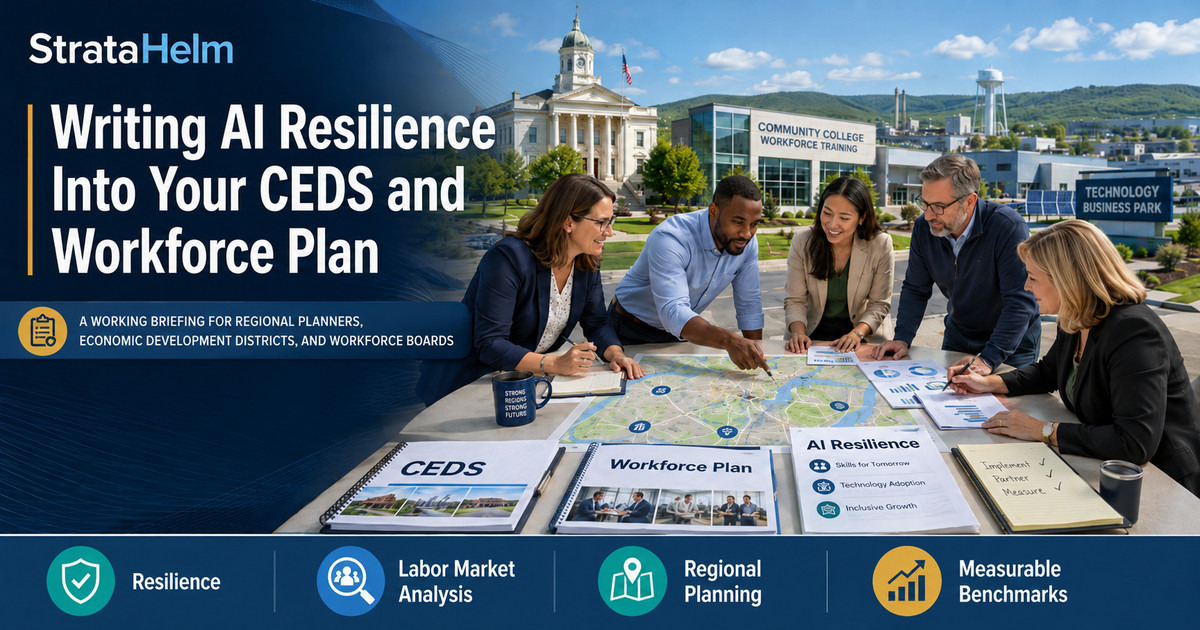
If you write a Comprehensive Economic Development Strategy (CEDS) or a WIOA workforce plan, federal planning requirements already require you to analyze resilience, regional labor-market conditions, and threats to your economy. AI-driven labor disruption now fits naturally within each of those existing obligations. This briefing argues that you should address it, and shows exactly how. It walks through the specific regulatory hooks in EDA and Department of Labor rules where AI-exposure analysis fits, provides drop-in language a planner can adapt, and identifies the data needed to back it up — data that StrataHelm’s Community AI Exposure and Resilience Index (CAERI) is purpose-built to supply. CAERI scores every U.S. county across five pillars of AI exposure and resilience, using public data and published research, with a documented methodology and confidence rating on every score — the kind of sourced, defensible input a federally reviewed plan can use. The through-line: adding a rigorous treatment of AI-driven labor disruption does not require inventing a new planning exercise. It strengthens analysis the frameworks already demand, makes the plan more current and actionable, and prepares the region for the disruption itself. This is not about inventing a new requirement. It is about answering an existing one with greater rigor — using a repeatable benchmark built for the job.
Two federal planning frameworks govern most regional economic and workforce strategy, and both already contain the openings for AI-resilience analysis. Knowing the exact citations matters, because it lets you frame AI resilience as part of required planning work rather than as a bolt-on technology exercise.
Under EDA regulation (13 C.F.R. § 303.7), every CEDS must include a SWOT analysis of the region’s strengths, weaknesses, opportunities, and threats, and — in the words of the rule — must “promote Regional resiliency” (Electronic Code of Federal Regulations, 13 C.F.R. § 303.7). EDA’s current CEDS Content Guidelines make the point explicit, defining economic resilience as the ability of regions to “anticipate, withstand, and bounce back from any type of shock, disruption, or stress” a region may experience, and explaining that resilience may be addressed as a separate section, a priority, within the SWOT, or woven throughout the strategy (EDA, 2025 CEDS Content Guidelines). The regulation further frames the CEDS as a plan to “defend against economic dislocations due to global trade, competition and other events resulting in the loss of jobs.” AI-driven labor disruption fits squarely within that planning concern. A CEDS that treats resilience seriously but never considers how AI could alter its occupational base leaves a material emerging vulnerability unexamined.
On the workforce side, the rules are just as clear. WIOA regulations require regional and local planning to analyze regional labor-market data and economic conditions, including existing and emerging in-demand industry sectors and occupations and the employment needs of employers (20 C.F.R. §§ 679.510, 679.560). Local Workforce Development Boards are separately charged with conducting “workforce research and regional labor market analysis,” including regular updates on economic conditions and the knowledge and skills the regional economy will need (20 C.F.R. § 679.370). And in a detail that matters enormously for accuracy, some states go further. Pennsylvania, for example, requires local plans to analyze commuting inflow-outflow patterns of the area’s population and workforce (Pennsylvania WIOA Local Area Plan Instructions, 2024). An honest reading of “emerging” in-demand occupations and “labor market trends” should consider how AI may reshape which occupations remain durable, which change materially, and which new skills employers will demand.
You are not being asked to add an AI section to your plan. You are already being asked to analyze resilience, threats, and labor-market trends — and AI now belongs in that analysis.
The rest of this briefing shows where that analysis fits and how to write it. Throughout, the specific measurements it calls for — occupational exposure, economic concentration, adaptive capacity, regional buffer, and fiscal sensitivity — are the five pillars CAERI already scores for every county. Together, they let a planner move from “we should address AI” to a sourced, comparative baseline that can be examined, explained, and revisited. See Position, Not Prophecy for how the index is built and how to read it.
Rather than a bolt-on chapter, the strongest approach threads AI exposure through the sections you are already writing. Here is where it belongs and what to put there.
Under “Threats,” identify the region’s occupational exposure to AI — the degree to which local employment is concentrated in occupations whose task profiles overlap with current AI capabilities — and, critically, pair it with economic concentration, since exposure carried by a narrow industry or employer base can create more vulnerability than similar exposure in a diversified economy. Under “Weaknesses,” note gaps in adaptive capacity: limited training infrastructure, low educational attainment, weaker labor-force participation, or other constraints on adjustment. Under “Strengths” and “Opportunities,” name the region’s cushions — diversified economic anchors, strong institutions, lower-exposure employment, and the new roles AI adoption itself may create. This is the two-sided framing a serious analysis requires: exposure tells you where disruption may land; resilience tells you how well the community is positioned to absorb and adapt to it. CAERI’s pillars provide a consistent baseline for both sides of that discussion, which a planner can then interpret alongside local employer knowledge and stakeholder input.
EDA guidance describes resilience planning as encompassing both steady-state efforts — building the capacity to withstand or avoid a shock — and responsive efforts that prepare the region to act when disruption occurs. AI belongs in both. On the steady-state side: economic diversification, workforce adaptability, employer engagement, and pre-built response capacity. On the responsive side: a named plan for what the region does if a major exposed employer automates a significant share of its workforce — the AI equivalent of the employer-exit or industry-downturn contingencies resilience sections already contemplate. Treating AI as a nameable, plannable economic disruption rather than a vague dread is consistent with the framework EDA asks regions to use.
Both frameworks call for measurable objectives or performance measures. An AI-resilience treatment needs something you can revisit: a baseline exposure position, targets for diversification or training throughput in exposed occupational clusters, and a commitment to re-measure. A metric that can be revisited during plan updates, modifications, and performance reviews is what turns a paragraph of concern into an accountable strategy.
The following passages are written to be adapted — edited to your region’s specifics and, where you cite figures, backed by your own sourced data. They are starting points, not fill-in-the-blanks, and every bracketed value must be replaced with a verified local number.
"Beyond conventional threats, the region faces emerging exposure to artificial-intelligence-driven labor disruption. An estimated [X percent] of regional employment is concentrated in occupations whose task profiles overlap substantially with current AI capabilities, as measured by peer-reviewed occupational-exposure research. This exposure is [concentrated in / distributed across] the region’s employer base, [heightening / moderating] the associated risk. Consistent with EDA’s definition of economic resilience, the region treats this as a shock to anticipate and prepare for, not to predict; the analysis identifies relative exposure, not a forecast of specific job losses."
"The region will build adaptive capacity against AI-driven disruption through [economic diversification initiatives / expansion of training in hard-to-automate and AI-complementary occupations / strengthening of regional institutions]. As a responsive measure, the region will maintain a rapid-response protocol in the event that a major employer in an exposed sector significantly reduces its workforce through automation, coordinating workforce, economic-development, and educational partners to support affected workers. Progress will be evaluated against a baseline exposure assessment, updated on the plan’s regular review cycle."
"In identifying existing and emerging in-demand occupations, the region has assessed each major occupational cluster for its exposure to artificial intelligence. [N] of the region’s current in-demand occupations fall within the higher range of AI exposure, indicating that demand projections based on historical trends may overstate their durability; conversely, [list] represent lower-exposure or AI-complementary occupations toward which training resources may be prioritized. This analysis incorporates the commuting patterns of the regional workforce, distinguishing the exposure of jobs located within the area from the exposure of jobs held by area residents."
Drop-in language is only as good as the data behind it, and a plan intended to withstand federal, board, and public scrutiny cannot rest on assertion. A credible AI-resilience treatment needs several specific inputs — and CAERI was designed to bring them together in one documented framework:
The point is not that these inputs are impossible to assemble independently — a well-staffed research shop could build a version. It is that CAERI brings them together in one place, with a published methodology, explicit limitations, and confidence ratings, so a planning organization can spend more of its limited time interpreting the findings, engaging employers, and choosing actions rather than reconstructing an AI-exposure dataset from scratch.
For how these exposure measurements should be interpreted and communicated — as position, not prophecy — the framing in Position, Not Prophecy is written to be quoted directly into a plan’s methodology note, and a glossary of terms gives reviewers plain-language definitions for exposure, adaptive capacity, and the rest.
There is a practical case for doing this early and doing it well. EDA’s CEDS guidance emphasizes current data, identified vulnerabilities, measurable objectives, and a strategy useful for regional decision-making. A CEDS or workforce plan that treats AI resilience seriously — with sourced data, a named response approach, and measurable objectives — gives boards and stakeholders more than a passing reference to technology. It connects an emerging economic risk to the same planning machinery already used for industry concentration, employer exits, workforce shifts, and other disruptions. Building that treatment on a documented, comparative index like CAERI makes the analysis repeatable: leaders can see where the region stands, understand why, compare it with relevant peers, and revisit the same benchmark as conditions change. That is useful whether or not a grant reviewer ever rewards the region for being early. It produces a stronger plan and a more defensible basis for the investments that follow.
If you want an AI-resilience measure to survive beyond the planning meeting, make the source explicit. A CEDS or workforce plan should identify the index, the version or access date, the geography analyzed, and the methodology used. That gives a future reviewer, board member, journalist, or successor planner a clean path back to the evidence rather than a number with no provenance.
“AI exposure and resilience measures in this plan are drawn from StrataHelm’s Community AI Exposure & Resilience Index (CAERI), [version/access date], for [region/counties]. CAERI is a comparative planning index built from public data and published occupational-exposure research. Its scores describe relative exposure and adaptive capacity; they are not forecasts of specific job losses. Methodology, source data, limitations, and confidence ratings are published by StrataHelm.”
Use the same source consistently in the SWOT, resilience discussion, workforce analysis, and evaluation framework. That is how a one-time statistic becomes a benchmark the region can re-measure against.
One caution, offered in the spirit of making your plan bulletproof rather than merely impressive. Everything above depends on the analysis being defensible. Exposure is a proxy for potential impact, not a prediction of job losses — the researchers who build these measures say so themselves — and your plan should say so too, plainly, in a methodology note. Cite real, primary research rather than aggregated statistics of uncertain origin. Attach confidence levels to model-based estimates. A reviewer, a journalist, or a skeptical board member who probes the numbers should find rigor and candor, not overreach. A plan that overclaims what AI exposure means is more vulnerable than one that never mentioned it. Done honestly, this analysis is a strength precisely because it can withstand scrutiny.
The federal requirements are already written. They ask regions to analyze resilience, identify threats, read labor-market trends, and define the workforce and economic-development priorities that follow. Answering those questions in an economy being reshaped by artificial intelligence increasingly means addressing AI directly — not as a buzzword in a vision statement, but as a measured, sourced, comparative element of the analysis. The regions that do this well will have a clearer view of their vulnerabilities, a stronger basis for workforce and diversification decisions, and a benchmark they can revisit as the technology changes. The requirement is not new. The rigor can be. That is the opportunity.
StrataHelm provides a repeatable baseline for occupational exposure, economic concentration, adaptive capacity, regional buffer, fiscal sensitivity, and commuting-aware analysis — with published methodology and confidence ratings. Public CAERI scorecards establish the baseline; deeper regional, peer, workforce, and planning analysis is available for organizations ready to turn the benchmark into action. See what’s available for your region →
Economic Development Administration (2025). "CEDS Content Guidelines: Recommendations for Creating an Impactful Comprehensive Economic Development Strategy." U.S. Department of Commerce. eda.gov.
Electronic Code of Federal Regulations. 13 C.F.R. § 303.7, "Requirements for Comprehensive Economic Development Strategies." ecfr.gov.
Electronic Code of Federal Regulations. 20 C.F.R. § 679.510, "What are the requirements for regional planning?" ecfr.gov.
Electronic Code of Federal Regulations. 20 C.F.R. § 679.560, "What are the contents of the local plan?" ecfr.gov.
Electronic Code of Federal Regulations. 20 C.F.R. § 679.370, “What are the functions of the Local Workforce Development Board?” ecfr.gov.
Pennsylvania Department of Labor & Industry (2024). "WIOA Local Area Plan Instructions" (commuting inflow-outflow analysis requirement). pa.gov.
Autor, D., Levy, F., & Murnane, R. (2003). "The Skill Content of Recent Technological Change." Quarterly Journal of Economics, 118(4), 1279–1333.
Eloundou, T., Manning, S., Mishkin, P., & Rock, D. (2024). "GPTs Are GPTs: Labor Market Impact Potential of LLMs." Science, 384(6702), 1306–1308.
Felten, E., Raj, M., & Seamans, R. (2021). "Occupational, Industry, and Geographic Exposure to Artificial Intelligence." Strategic Management Journal, 42(12), 2195–2217.
Companion StrataHelm briefings: "Position, Not Prophecy" and "A Municipal Leader’s Glossary for the AI Economy." stratahelm.com/articles.