 HomeCountiesArticlesMethodologyContact
A Data-Driven Review of Government Programs After Mass Job Loss — the Successes, the Failures, and the Fine Print
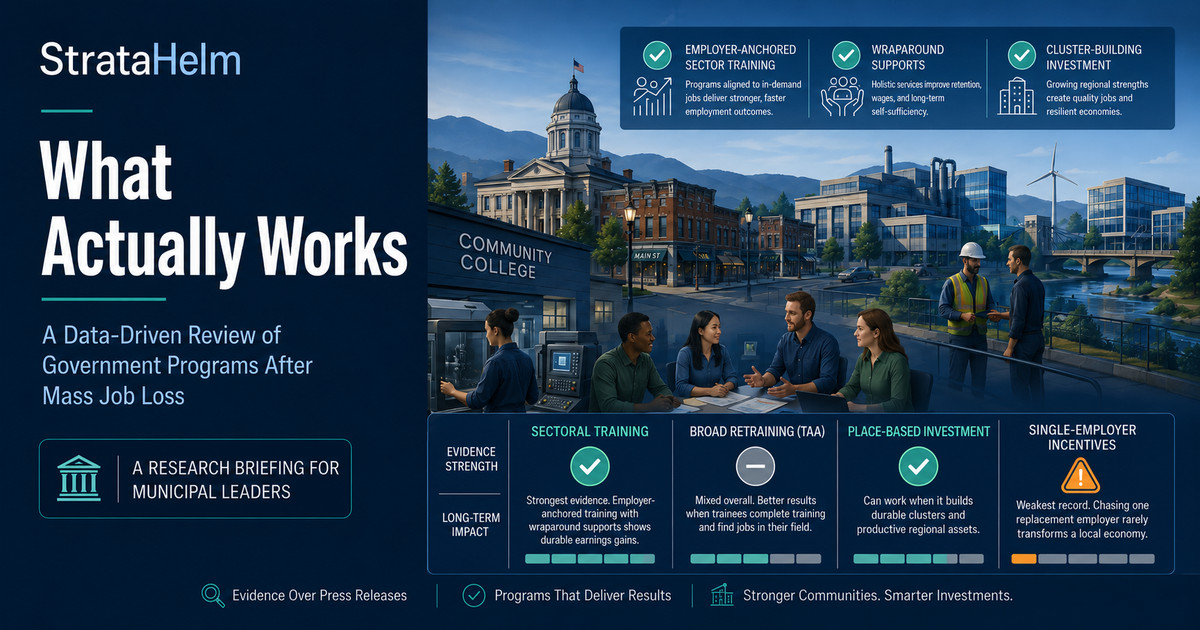
When a community loses a large share of its jobs, governments reach for a familiar toolkit: retraining programs, cash assistance, tax incentives, and big place-based investments. Decades of evaluation research — including randomized controlled trials, the gold standard of program evidence — now let us say which tools actually move earnings and employment, and which mostly move press releases. The short version: sector-focused training programs tied to real local employers show the strongest, most durable results ever measured in workforce policy, with earnings gains persisting nine to fourteen years. Broad federal retraining (Trade Adjustment Assistance) shows mixed results overall but meaningful gains for workers who complete training and find jobs in their field. Large place-based investments (like the Tennessee Valley Authority) can permanently reshape a region — if they build a self-sustaining industrial cluster before the money stops. And the most popular tool of all — chasing a single replacement employer with incentives — has the weakest record.
Every program that serves displaced workers can point to graduates with new jobs. The hard question is the counterfactual: what would have happened without the program? The best studies answer this with randomized controlled trials (RCTs) — randomly assigning applicants to the program or a control group and tracking both for years — or with clever natural experiments. This briefing prioritizes that tier of evidence. It is worth the rigor: the history of workforce policy is littered with programs whose glowing early results faded on closer inspection (Straight Talk on Evidence, 2019).
The strongest evidence in the field comes from "sectoral" training programs — programs that (1) train for specific high-growth sectors of the local economy where well-paying jobs actually exist, (2) partner closely with local employers on curriculum and hiring, and (3) wrap participants in supports like case management, childcare help, and stipends (Straight Talk on Evidence, 2019; Katz et al., NBER, 2020).
The pattern behind every success: train for jobs that verifiably exist locally, co-design with the employers who will do the hiring, and support the whole person — not just the skill.
One honest caveat: not every sectoral program replicates these results, and the standouts screen applicants and demand full-time commitment (Brookings, 2022). These are not drop-in workshops; they are intensive, employer-anchored pipelines. Municipal leaders funding training should insist on the full model, not the cheap imitation.
Trade Adjustment Assistance (TAA), the flagship federal program for trade-displaced workers, offers training, income support, and relocation allowances. The definitive nine-year national evaluation found that TAA substantially increased receipt of training and services, but produced neutral-to-slightly-positive employment effects and mixed wage effects overall — in part because participants spent years in training while comparison workers were re-earning (D’Amico & Schochet, 2012; USITC briefing). The fine print is the useful part: workers who completed their training and found a job in their field earned a $5,000–$6,000 per year boost — the problem was that only about 37 percent of training completers managed to land in-field jobs (The Century Foundation, 2021). TAA’s weakness was not training per se; it was training disconnected from actual local demand. That is precisely the flaw the sectoral model fixes.
The Tennessee Valley Authority remains the largest place-based experiment in American history: dams, cheap electricity, roads, and schools poured into one of the nation’s poorest regions beginning in 1933, with federal investment tapering after 1960. Economists Patrick Kline and Enrico Moretti tracked outcomes over seventy years using regions that were proposed for similar authorities but never approved as controls. Their finding: gains in agricultural employment reversed once subsidies ended, but gains in manufacturing employment kept intensifying long after the federal money stopped — because the investment had seeded a self-reinforcing manufacturing cluster ("agglomeration economies") that shifted the region from a low-wage sector to a high-wage one (Kline & Moretti, 2014).
The condition, then: place-based investment works when it builds durable clusters and infrastructure that make the region genuinely more productive — and fizzles when it merely subsidizes activity that evaporates with the subsidy. For a modern municipal application, think broadband, workforce pipelines, and industry clusters rather than one-off incentive checks.
Mass job loss is survivable — but not by improvisation. The evidence points to an unglamorous formula: employer-anchored sectoral training, delivered intensively with human supports, layered on top of patient investments in the region’s genuine productive advantages. It will never produce a ribbon-cutting as photogenic as a new factory announcement. It will just work — which, fourteen years of RCT data suggests, is more than can be said for most of the alternatives.
Brookings Institution (2022). "Do Sectoral Training Programs Work? What the Evidence on Project QUEST and Year Up Really Shows." brookings.edu.
D’Amico, R., & Schochet, P. (2012). "The Evaluation of the Trade Adjustment Assistance Program: A Synthesis of Major Findings." U.S. Department of Labor / Mathematica Policy Research.
Economic Mobility Catalog / Results for America (2024). "Sector-Specific Job Training." catalog.results4america.org.
Fein, D., et al. (2021). Year Up long-term impact findings, Pathways for Advancing Careers and Education (PACE) evaluation, U.S. DHHS.
Jacobson, L., LaLonde, R., & Sullivan, D. (1993). "Earnings Losses of Displaced Workers." American Economic Review, 83(4), 685–709.
Katz, L., Roth, J., Hendra, R., & Schaberg, K. (2020). "Why Do Sectoral Employment Programs Work? Lessons from WorkAdvance." NBER Working Paper 28248.
Kauffman Foundation. "The Dos and Don’ts of Local Entrepreneurship Promotion." Entrepreneurship Policy Digest. kauffman.org.
Kline, P., & Moretti, E. (2014). "Local Economic Development, Agglomeration Economies, and the Big Push: 100 Years of Evidence from the Tennessee Valley Authority." Quarterly Journal of Economics, 129(1), 275–331.
Roder, A., & Elliott, M. (2019). "Nine Year Gains: Project QUEST’s Continuing Impact." Economic Mobility Corporation.
Russo, J., & Linkon, S. (2023). "Recalibrating Expectations: Lessons from Youngstown, Ohio." The Future of Cities.
Straight Talk on Evidence (2019). "Not All Program Effects Fade: New Report on the Project QUEST RCT." straighttalkonevidence.org.
The Century Foundation (2021). "Testimony: Improving Trade Adjustment Assistance." tcf.org.
U.S. International Trade Commission. "Evaluations of the Trade Adjustment Assistance Program." Executive Briefing on Trade.
WorkRise / Urban Institute (2021). "Evidence from Sector-Focused Training Programs Shows Significant and Persistent Earnings Gains." workrisenetwork.org.