 HomeCountiesArticlesMethodologyContact
Why Preparing for AI Disruption Pays Off Even If the Worst Never Comes
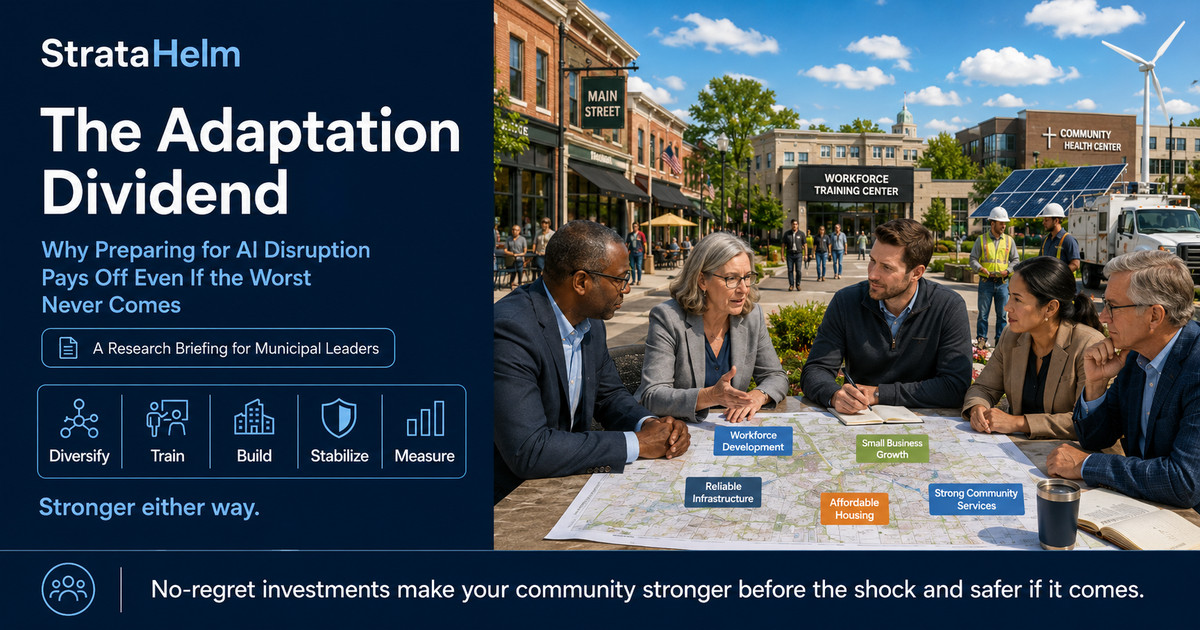
Every municipal leader weighing whether to prepare for AI-driven disruption runs into the same paralyzing question: what if we spend the money and effort, and the disruption turns out to be overhyped? It is a fair question, and it stops a great deal of sensible action cold. This briefing offers a way out of the paralysis, borrowed from a field that has wrestled with exactly this problem for thirty years — climate adaptation. The key concept is the "no-regret" investment: an action worth taking under every plausible future, including the one where the feared disruption never arrives, because it delivers benefits on its own terms. The central argument here is that most of what a community should do to prepare for AI — diversify its economy, strengthen its workforce, build entrepreneurial capacity, shore up its finances, and measure its own position honestly — are no-regret investments. They make a community stronger, more stable, and more prosperous whether or not AI disrupts a single job. The disruption, if it comes, is simply the reason you are glad you started. The preparation pays a dividend either way. Understood this way, the decision to prepare stops being a bet on a scary forecast and becomes what it actually is: good governance that also happens to be good insurance.
The reason so many communities freeze is a genuine intellectual bind, not mere timidity. Preparing for a disruption whose timing and severity nobody can predict feels like gambling public money on a guess. Prepare too aggressively for a disruption that fizzles, and you have wasted scarce resources and political capital. Prepare too little for one that arrives, and you have failed the community. Faced with that dilemma and deep uncertainty about which way it will break, the safest-feeling choice is to wait for more information — which is to say, to do nothing until the disruption is already underway and preparation is no longer possible. This is precisely the trap that has caught deindustrializing towns for fifty years: the response arrives after the damage, never before. The way out is not a better forecast. It is a better kind of investment.
Climate-adaptation economists confront a harder version of this exact problem — how to justify spending today against an uncertain, contested, decades-out threat — and they developed a clean answer. They distinguish between two kinds of preparation. The first is a pure hedge, like an insurance premium: money spent that produces nothing unless the bad event occurs. The second, and far more attractive, is the "no-regret" option. As the World Bank defines it, no-regret measures are those "justified under all plausible future scenarios, including the absence of" the threat — activities that deliver benefits even if the feared event never happens (World Bank; IUCN, 2013). The Intergovernmental Panel on Climate Change put it even more simply: no-regret measures are those "worth undertaking whether or not there are climate-related reasons for doing so" (IPCC, Second Assessment Report, 1996). They are sometimes called negative-cost options, because their ordinary benefits already exceed their costs before you count the avoided disaster at all.
An insurance premium is money you are glad to have wasted. A no-regret investment is money that was already working for you — the protection was the bonus.
This distinction transforms the AI-preparation debate. The paralyzing question — "what if the disruption never comes?" — only has force against insurance-type spending. Against a no-regret investment, it has no force at all, because the investment was worth making regardless. The entire strategic task, then, is to identify which AI-preparation measures are no-regret investments rather than speculative hedges — and to favor them. It turns out that most of the important ones qualify.
The single most important AI-resilience move a concentrated community can make — broadening its economic base so it does not depend on a narrow set of exposed employers — is also just sound economic policy, independent of AI entirely. The evidence here rests on a simple and well-established analogy to financial portfolios: a diversified portfolio of industry employment yields lower overall volatility, exactly as a diversified portfolio of investments does (Barth et al., 2015). Research treating natural disasters as external shocks found that economic diversity dampens both the magnitude and the duration of a shock’s effect on local economies, and that outmigration after a disaster is lower in more diverse cities (Coulson et al., 2020). A community that diversifies to guard against AI is, in the same act, guarding against recessions, plant closures, natural disasters, and the next unforeseen shock of any kind. If AI disruption never materializes, the community is simply left more stable and less fragile. That is the definition of no-regret.
Investing in workforce adaptability — sectoral training tied to real local demand, stackable credentials, strong community-college pipelines — is the second no-regret pillar. The randomized-trial evidence is unambiguous that well-designed training produces large, durable earnings gains: participants in the best programs earned significantly more than control groups nine and even fourteen years later, in a labor market that had nothing to do with AI. A workforce that can retrain and adapt is more productive, better paid, and more attractive to employers under any economic conditions. Whether or not AI reshapes the local job market, a community that has built the capacity to move workers into good jobs has made its residents wealthier and its economy more competitive. The AI threat is a reason to start now; the payoff arrives regardless.
The specific programs with the strongest evidence — and the ones to avoid — are covered in What Actually Works.
Building the local ability to start and grow new firms — through founder networks, mentorship, and friction-free permitting rather than empty incubator buildings — is a no-regret investment because new and young firms are responsible for nearly all net new job creation in the economy, in good times and bad. A community that gets better at growing its own businesses is more prosperous whether the jobs it needs to replace were lost to AI, to trade, to a factory relocation, or to nothing at all. The entrepreneurial ecosystem you build as an AI hedge is the same ecosystem that quietly compounds your economy every year the hedge goes unused.
What actually builds that capacity — and what merely looks like it does — is the subject of a companion briefing, Planting After the Storm, published September 15.
Strengthening a local government’s own finances — building reserves, diversifying revenue, stress-testing the budget against downturns — is perhaps the purest no-regret investment of all, because it prepares the community for every possible shock simultaneously. A reserve fund built in anticipation of AI-driven tax-base erosion is exactly as useful against a recession, a natural disaster, a state-aid cut, or a pandemic. Sound public finance is never wasted. A community that shores up its fiscal position because it is worried about AI has, as a pure byproduct, made itself more resilient to threats it has not even thought of.
Finally, the cheapest no-regret investment: simply knowing your own position. Measuring a community’s economic concentration, its workforce’s exposure, its commuting patterns, and its fiscal sensitivities produces better decisions across the entire range of local governance — economic development, workforce planning, budgeting — whether or not AI is the shock that eventually tests them. Good data about your own economy is a standing asset. It informs the CEDS, the workforce plan, the budget, and the next employer negotiation regardless of what the future holds. You do not have to believe a word of the AI forecast to benefit from understanding your own community better.
Lay the logic out as a decision under uncertainty and the paralysis dissolves. There are two things you can do — prepare, or wait — and two ways the future can break — disruption comes, or it does not. That gives four outcomes. If you prepare and disruption comes, you are ready. If you prepare and it does not come, you are left with a more diversified, better-skilled, more entrepreneurial, more fiscally sound, better-measured community — hardly a punishment. If you wait and disruption comes, you suffer the deindustrialization pattern in full: the response too late, the damage done. If you wait and it does not come, you got lucky. Three of the four outcomes favor preparing, and the one that favors waiting depends entirely on being right about a forecast nobody can make. When the cost of preparing is low — because the preparations pay for themselves — the decision is not close.
You are not betting on the AI forecast. You are building a stronger community and getting the insurance for free.
Intellectual honesty requires marking the limits of this argument, because overselling it would be exactly the kind of overclaim this publication warns against. Two caveats matter. First, the diversification-and-stability literature, while substantial, is not unanimous — a handful of studies have found weak or no relationship between diversity and stability, and what matters is not raw diversity but the right mix of industries whose fortunes do not rise and fall together (Malizia & Ke, 1993; and see the broader debate). Diversification done carelessly — chasing any employer regardless of fit — is not automatically a win. Second, not every AI-specific measure is no-regret. Buying an expensive, narrowly AI-focused technology platform, or restructuring a local economy around a specific and unproven prediction about which jobs will vanish and when, is a genuine speculative bet, and should be recognized and scrutinized as one. The discipline this framework demands is to keep asking, of every proposed action: would we still be glad we did this if the AI disruption never arrived? Where the answer is yes, proceed with confidence. Where it is no, treat it as the real gamble it is, and size it accordingly.
The fear of wasting resources on a disruption that never comes is the single biggest reason communities fail to prepare — and it is, for the most important preparations, simply misplaced. Diversifying an economy, strengthening a workforce, building entrepreneurial capacity, shoring up public finances, and understanding one’s own position are not bets on an AI forecast. They are the fundamentals of a strong, resilient community, worth doing in a world where AI changes everything and equally worth doing in a world where it changes far less than the headlines promise. That is the adaptation dividend: the preparation is its own reward, and the readiness is the bonus. A leader who grasps this is freed from the impossible task of predicting the future and handed a far simpler one — building a community strong enough that the future, whatever it holds, is something to be met rather than feared. The worst may never come. You should prepare anyway, because you will be glad you did either way.
For how to measure the position these investments are meant to strengthen — and how to read that measure honestly — see Position, Not Prophecy.
Knowing your community’s position is the cheapest no-regret investment there is — and every U.S. county’s CAERI scorecard is free to look up. See where your community stands →
Barth, J., et al. (2015), as discussed in Coulson, N. E., et al. (2020). "Economic Diversification and the Resiliency Hypothesis: Evidence from the Impact of Natural Disasters on Regional Housing Values." (portfolio theory and metro employment volatility).
Coulson, N. E., Dong, Z., & Sing, T. F. (2020). "Economic Diversification and the Resiliency Hypothesis." Regional Science and Urban Economics / ScienceDirect (diversity dampens magnitude and duration of shocks; lower post-disaster outmigration).
Intergovernmental Panel on Climate Change (1996). Second Assessment Report ("measures worth undertaking whether or not there are climate-related reasons for doing so"); and AR5 (2014), Chapter 14, on no-, low-, and win-win adaptation strategies.
IUCN / UNEP / UNDP (2013). "Ecosystem-Based Adaptation: Building on No-Regret Actions" (World Bank definition of no-regret options). iucn.org.
Malizia, E., & Ke, S. (1993). "The Influence of Economic Diversity on Unemployment and Stability." Journal of Regional Science, 33(2), 221–235 (and the broader diversity-stability debate).
Companion StrataHelm briefings: "What Actually Works," "Planting After the Storm," and "Position, Not Prophecy." stratahelm.com/articles.